Table Of Content
It should make intuitive sense that the less consistent the effect of dosage, the larger the dosage effect would have to be in order to be significant. The degree to which the effect of dosage differs depending on the subject is the \(Subjects \times Dosage\)interaction. Recall that an interaction occurs when the effect of one variable differs depending on the level of another variable. In this case, the size of the error term is the extent to which the effect of the variable "Dosage" differs depending on the level of the variable "Subjects." Note that each subject is a different level of the variable "Subjects." If the means for the two dosage levels were equal, the sum of squares would be zero. A between-subjects design would require a large participant pool in order to reach a similar level of statistical significance as a within-subjects design.
Reduces Errors Caused by Individual Differences
Counterbalancing is sometimes more convenient for researchers because an even portion of the sample undergoes each sequence of conditions selected by researchers. Each treatment ideally appears equally often in each position (e.g., third) of the sequence. Although the within-subjects design is a great choice for many types of experiments, it doesn't fit all of them. For those it does fit, there are also limitations that researchers should be aware of to improve the design of their study.
Examples of Within Subject Designs
Children deny that God can change fundamental moral principles, study finds - PsyPost
Children deny that God can change fundamental moral principles, study finds.
Posted: Sat, 06 Jan 2024 08:00:00 GMT [source]
It’s the opposite of a between-subjects design, where each participant experiences only one condition. When deciding the design of your experiments, it's important to understand the strengths and weaknesses of the options available to you. This key characteristic would be the independent variable, with varying levels of the characteristic differentiating the groups from each other.
Design Differences
This includes psychotherapies and medical treatments for psychological disorders but also interventions designed to improve learning, promote conservation, reduce prejudice, and so on. To determine whether a treatment works, participants are randomly assigned to either a treatment condition, in which they receive the treatment, or a control condition, in which they do not receive the treatment. In research on the effectiveness of psychotherapies and medical treatments, this type of experiment is often called a randomized clinical trial. A within-subjects design is an experimental design in which the same group of participants is exposed to all independent variable levels.
The Advantages of Within Subject Designs
In this article, we'll be taking a detailed look at within-subjects design, and comparing it to between-subjects design. A final method for dealing with violations of sphericity is to use a multivariate approach to within-subjects variables. The first source of variation, "Subjects," refers to the differences among subjects. If all the subjects had exactly the same mean (across the two dosages), then the sum of squares for subjects would be zero; the more subjects differ from each other, the larger the sum of squares subjects. A between-subjects design is also useful when you want to compare groups that differ on a key characteristic.
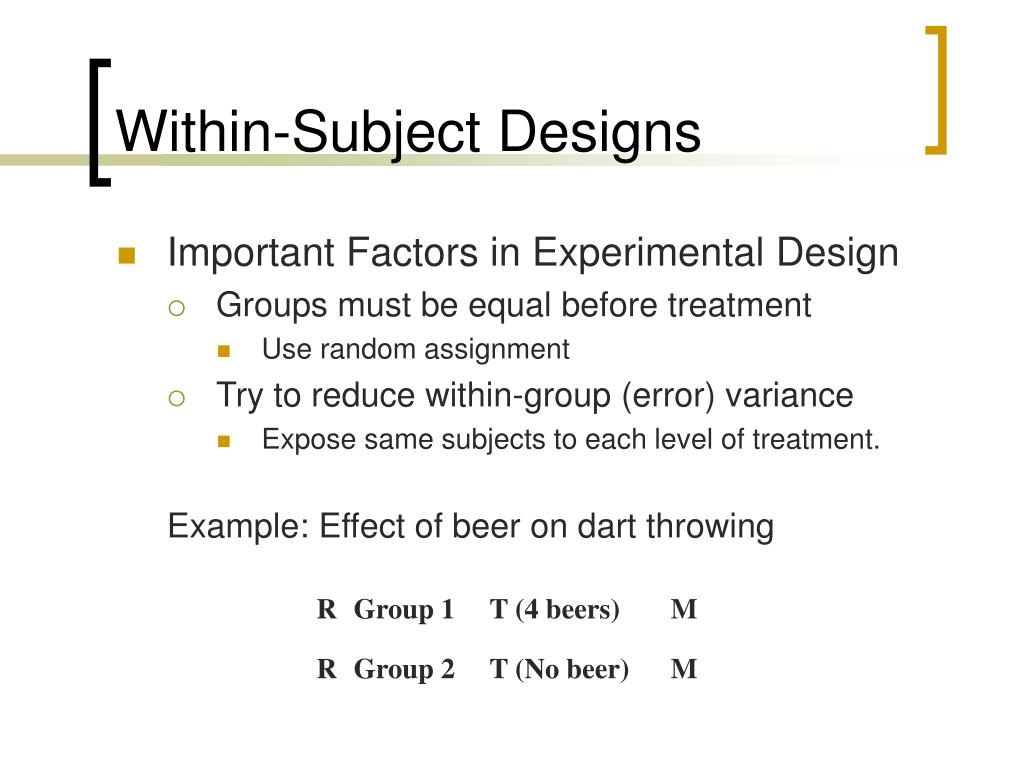
A within-subjects design is a type of experimental design in which all participants are exposed to every treatment or condition. Within-subjects designs require smaller sample sizes as each participant provides repeated measures for each treatment condition. Researchers test the same participants repeatedly across all treatments to assess for differences between the variables.
Simultaneous Within-Subjects Designs
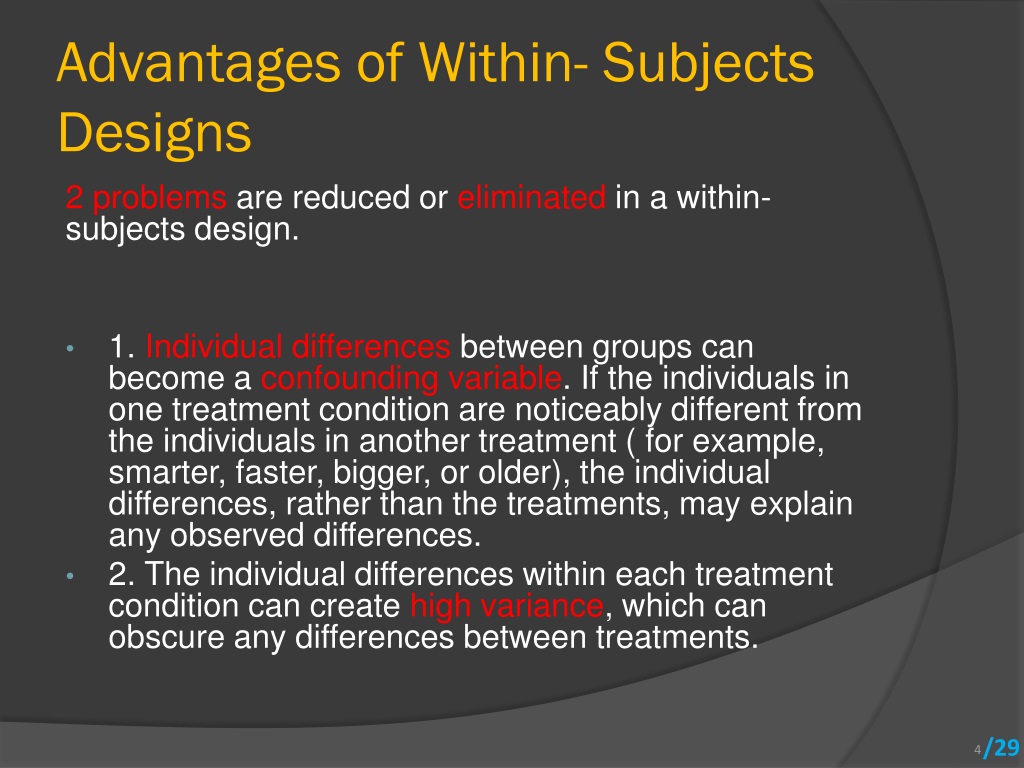
A within-subjects design is a great option if participants and resources tend to be limited. In a within-subject design, individuals are exposed to all levels of a treatment, so individual differences will not distort the results. This article discusses what a within-subjects design is, how this type of experimental design works, and how it compares to a between-subjects design.
One-Factor Designs
Thus any overall difference in the dependent variable between the two conditions cannot have been caused by the order of conditions. A second way to think about what counterbalancing accomplishes is that if there are carryover effects, it makes it possible to detect them. One can analyze the data separately for each order to see whether it had an effect. There is a solution to the problem of order effects that can be used in many situations. Using counterbalancing, the researcher(s) can have an equal or similar number of participants complete each possible order of conditions.
Choosing from between-subjects and within-subjects designs
The surprising result was that all participants improved in terms of both knee pain and function, and the sham surgery group improved just as much as the treatment groups. A major drawback of using a within-subject design is that the sheer act of having participants take part in one condition can impact the performance or behavior on all other conditions, a problem known as a carryover effect. Data collection can take a long time since each participant is given multiple treatments.
You typically would use a within-subjects design when you want to investigate a causal or correlational relationship between variables with a relatively small sample. Participants may become exhausted, bored, or less motivated after taking part in multiple treatments or tests. This type of experimental design can be advantageous in some cases, but there are some potential drawbacks to consider. Afterward, the results of the memory tests would be compared to see how the type of exercise influenced memory. So one group of participants would receive one treatment, while another group would receive a different treatment. Between-subjects and within-subjects designs can be used in place of each other or in conjunction with each other.
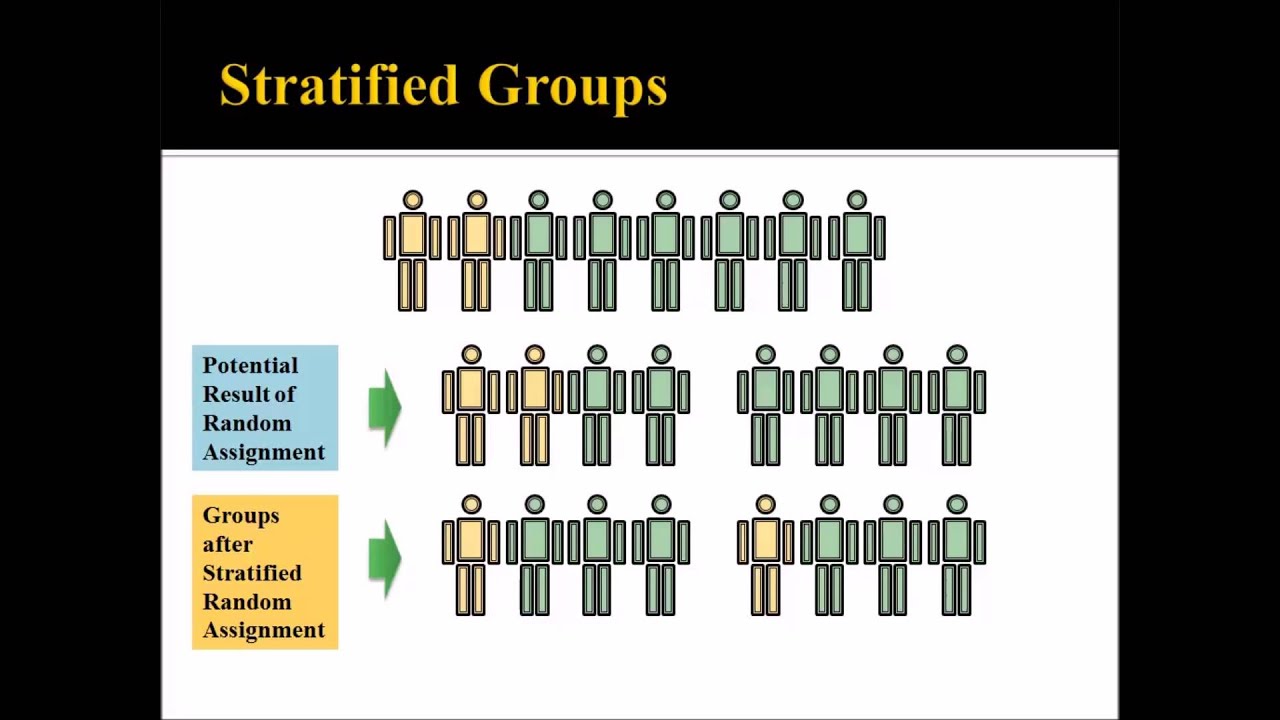
With counterbalancing, participants are assigned to orders randomly, using the techniques we have already discussed. Thus random assignment plays an important role in within-subjects designs just as in between-subjects designs. Here, instead of randomly assigning to conditions, they are randomly assigned to different orders of conditions. In fact, it can safely be said that if a study does not involve random assignment in one form or another, it is not an experiment. Between-subjects design is generally more suitable for studying between-subjects differences, such as the effects of different treatments or the influence of individual characteristics on a response.
Shorter sessions are less tiring (or boring) for users and can also be more appropriate for remote unmoderated testing (especially since tools like UserZoom usually require a fairly short session length). So, for instance, in our earlier example, having participants take part in yoga might impact their later performance in jogging and may even affect their performance on later memory tests. For example, exposure to a reaction time test could make participants’ reaction times faster in a subsequent treatment due to familiarity with the study. In order to determine which medication is going to be the most beneficial for her patients, she measures each child’s performance four times, once after being on each of four drug doses for a week.




No comments:
Post a Comment